






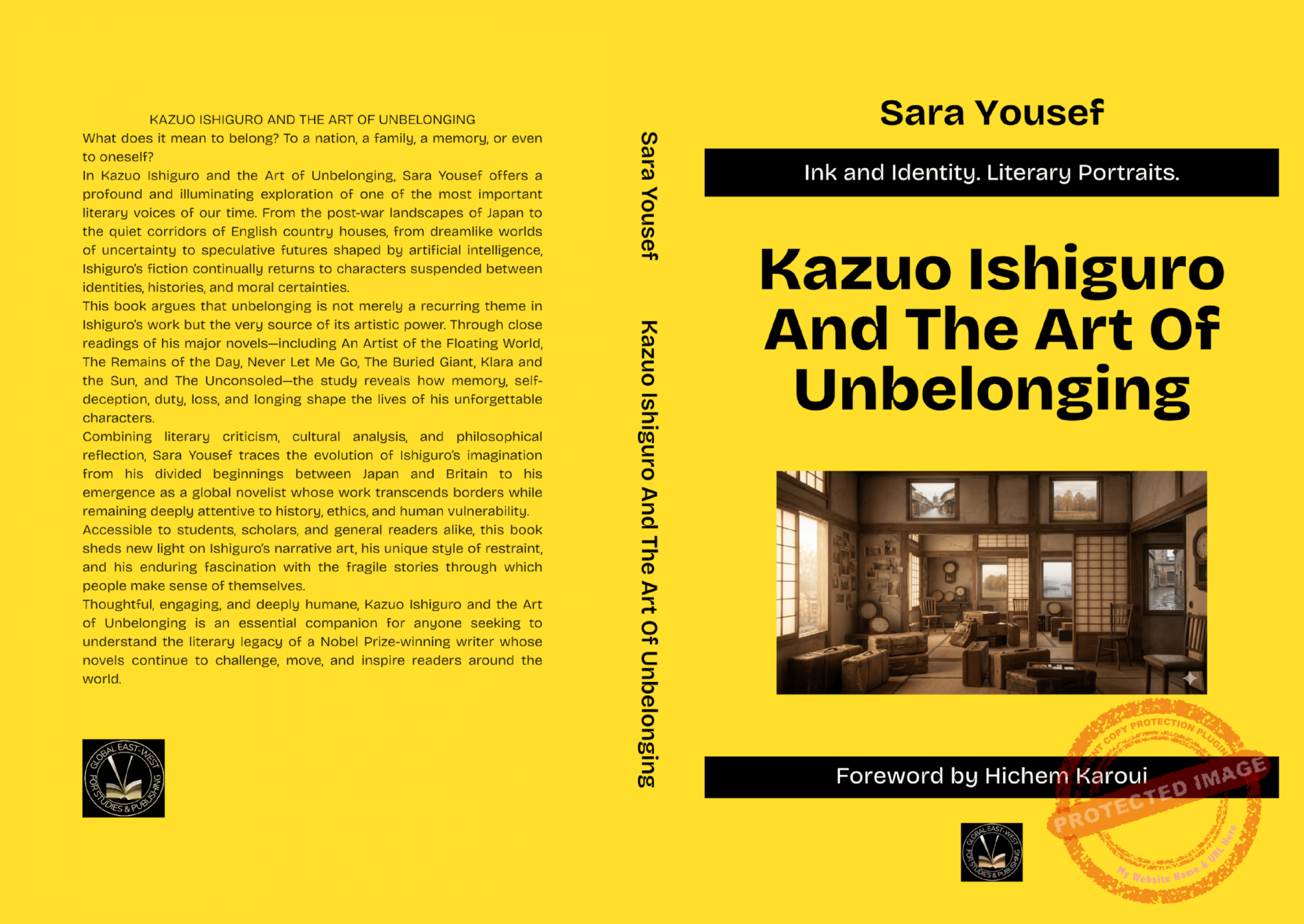
 Sara Yousef (author)
Foreword by Hichem Karoui
- Publisher : Global East-West For Studies and Publishing (GEW).
- Publication date : June 11, 2026
- Language : English
- Print length : 352 pages
A major critical study of Nobel Prize-winning novelist Kazuo Ishiguro.
Kazuo Ishiguro and the Art of Unbelonging examines the complete literary achievement of one of the most influential contemporary writers in English. Through a rich and accessible analysis of Ishiguro’s novels, stories, themes, and intellectual influences, Sara Yousef demonstrates how the experience of unbelonging lies at the heart of his creative vision.
From the remembered Japan of A Pale View of Hills and An Artist of the Floating World to the English world of The Remains of the Day, from the dystopian tragedy of Never Let Me Go to the ethical questions raised by Klara and the Sun, Ishiguro’s fiction explores memory, identity, displacement, moral responsibility, and the search for meaning in uncertain times.
Rather than treating Ishiguro merely as a British or Japanese writer, this book presents him as a global literary figure whose work transcends national boundaries while remaining deeply rooted in questions of history, belonging, and human connection.
Readers will discover:
• The role of migration and cultural hybridity in Ishiguro’s imagination.
• The importance of memory, forgetting, and self-deception.
• The ethical dimensions of his narrators and protagonists.
• His engagement with postcolonialism, technology, and artificial intelligence.
• The influence of music, silence, and narrative restraint on his style.
• The significance of his Nobel Prize and global literary legacy.
Written in a clear and engaging style, this volume is ideal for students of literature, book clubs, researchers, and anyone interested in contemporary fiction.
A compelling journey through the worlds of Kazuo Ishiguro, this book reveals why his fiction continues to resonate across cultures and generations.
Buy it now From Amazon: https://www.amazon.com/Kazuo-Ishiguro-Art-Unbelonging-Identity/dp/1787957640
Buy it Now From any retailer on the Web: https://books2read.com/u/4De95Q
Foreword
Divided Beginnings
By Hichem Karoui
I stumbled across “The Unconsoled” while scanning a shelf in the British Council library in Tunis. It must have been the year it was published or the following year. I borrowed it along with a few other books. I didn’t know much about the author at the time. As soon as I started reading it, I couldn’t put it down. What struck me then was that flow of words going against the grain. That style of writing that couldn’t care less about ‘real’ time and makes no attempt whatsoever to make the narrative a mirror of our world. Like, for example, a conversation—or perhaps a monologue—in a lift that keeps going up—or down; I can’t remember—and the conversation (or monologue) goes on for pages and pages. Time stood still, as in Aragon’s poem ‘Les chambres.’
Time—as far as I’m concerned—has passed since then. But the image has remained etched in my mind. So too has the way the narrator recounts what is happening. To be honest, despite all the novels I’ve read since I started reading, the authors who have impressed me most are mainly those we now call classics. But, from the twentieth century onwards, I can now count Ishiguro among the contemporaries, whom I discovered in the 1990s.
His writing style is distinguished by traits that are uniquely his own. Style, Nietzsche said, is personality.
Few modern novelists have had the courage to explore the void and nothingness as Ishiguro has done. What he says can be summed up in a single sentence: the novel is a world unto itself. Its space-time is the only possible reality.
Kazuo Ishiguro’s career begins with an apparent contradiction: he is one of the most recognisable voices in British literature, yet his imaginative foundations are inseparable from a sense of distance, migration, and partial inheritance. This introductory chapter argues that unbelonging is not a wound his work merely records but a generative condition that gives it its peculiar moral depth and formal beauty.
A Writer Formed Between Worlds
Biography as threshold, not explanation
To begin with Ishiguro is to begin with movement. Born in Nagasaki in 1954 and brought to Britain as a small child when his father accepted a scientific post, he grew up not in the aftermath of one nation alone, but in the overlap between two. That fact has often tempted critics into a simplified story: the Japanese-born, British-raised novelist as natural spokesman for cultural hybridity. Yet Ishiguro’s achievement lies precisely in resisting easy conversion of biography into a theme. His fiction does not simply mirror his life; it transforms the experience of in-betweenness into a more elusive artistic principle. The worlds his narrators inhabit are rarely secure enough to count as home and rarely alien enough to be dismissed as other. Instead, they are places of provisional attachment, where memory, duty, self-deception, and longing shape consciousness more powerfully than geography alone.
This is why divided beginnings matter. They suggest not only a split between Japan and Britain but also a larger habit of perception. Ishiguro’s work repeatedly asks what it means to stand just outside the stories that are supposed to define us. Family history, national culture, class identity, professional code, and even intimate love all appear in his fiction as structures that promise coherence while quietly exposing fracture. His protagonists tend to speak from within established orders, but they do so with the unease of people who cannot entirely trust the language available to them. As a result, the reader enters a narrative atmosphere shaped by hesitation. We are invited to listen not simply for what is said, but for what cannot be comfortably admitted.
In that sense, unbelonging is less a social category than an aesthetic and ethical disposition. It enables Ishiguro to craft characters who are representative but also estranged, placed within specific cultural moments but also a little bit removed from them. Such a vantage point gives his fiction its remarkable balance of intimacy and distance. He can inhabit the mind of a butler, a painter, a child clone, or an artificial companion, not by claiming mastery over their worlds but by tracing the fragile stories through which each tries to secure a place in them. The emotional power of these narratives comes from the fact that belonging is never assumed. It must be imagined, rehearsed, defended, and sometimes mourned.
The Roots of Unbelonging
Early life between Japan and England
Although Ishiguro left Japan at the age of five, Japan remained a powerful imaginative presence in the household of his childhood. This distance is crucial. He did not grow into Japanese society through ordinary participation, nor did he abandon it completely. Instead, he encountered it through recollection, conversation, parental memory, and the suspended possibility of return. Such conditions create an unusual relationship to origin. A homeland becomes less a stable environment than a mental composition, part inheritance and part invention. For a future novelist, this is formative. It teaches that places are not simply inhabited; they are narrated. They survive in gestures, tonalities, silences, and fragments of family lore, often more vividly than in direct experience.
At the same time, Britain was not merely the neutral setting in which Ishiguro matured. It was the country in which he was educated, socialised, and professionally recognised, but it too could not be received as an entirely uncomplicated home. For a child raised in suburban England while conscious of another lineage, cultural assimilation would never be a single completed event. One learns the codes of one’s society while remaining faintly aware that one’s presence is also interpreted through assumptions about elsewhere. This double consciousness does not have to announce itself dramatically to shape a sensibility. It may register instead as caution, alertness, or the perception that identity is always being translated. Much in Ishiguro’s fiction depends upon precisely such tonal states.
The value of this early experience is not that it gave Ishiguro authentic access to two neatly bounded cultures. On the contrary, it exposed the instability of such boundaries. The Japan of his childhood memory was already mediated; the Britain of his upbringing was never entirely innocent of social hierarchies and exclusions. His later fiction would move far beyond autobiographical material, but it would preserve this understanding that identity is assembled under conditions of incompleteness. To belong absolutely is, in his world, almost always a fantasy. What people possess instead are arrangements of loyalty and performance, patterns of feeling by which they persuade themselves that they stand securely somewhere.
Family, Inheritance, and the Authorial Voice
Private influence and imaginative discipline
Any account of Ishiguro’s early formation must pause over family, because family in his case provided more than affection or biography; it offered a model of how the past lives on through retelling. His parents carried with them memories of pre-war and post-war Japan, and the child who listened inherited not full knowledge but charged fragments. Such inheritance is structurally similar to much in his later fiction, where narrators reconstruct meaning from partial records and emotionally burdened recollections. What is passed down is never complete. It arrives with omissions, distortions, and idealisations, and the recipient must fashion coherence from what remains unresolved. This is one reason Ishiguro’s prose is so attentive to what lies just beyond declarative certainty.
Family also sharpened his sensitivity to the relationship between personal life and larger history. In many of his novels, private memory is inseparable from national transition or collective trauma. This pattern should not be mistaken for simple historical allegory. Rather, Ishiguro shows that history enters ordinary consciousness unevenly, through shame, nostalgia, discipline, or a need to justify one’s choices. The family sphere is often where such pressures are first felt. Expectations about dignity, sacrifice, respectability, emotional restraint, and social role become internal habits long before they are recognised as cultural scripts. Ishiguro’s narrators frequently speak as though they are merely recounting personal experience, yet their voices reveal inherited systems of value they can neither wholly endorse nor wholly escape.
This is where the art of inheritance becomes central to his voice. Ishiguro does not treat inheritance as passive reception. He reshapes it through careful formal control, turning uncertainty into method. His narrators circle around painful recognitions, delay conclusions, and organise recollection with almost ritual tact. Such composure suggests an ethic as much as a style. One must speak responsibly about lives one cannot fully know, including one’s own. The result is fiction that sounds modest while achieving extraordinary complexity. Its authority comes not from total access, but from disciplined partiality.
From Music to Prose
Rhythm, restraint, and the withheld note
Before becoming known as a novelist, Ishiguro imagined a life in music. That early ambition matters not because it offers a charming prelude to literary success, but because it clarifies certain habits of construction in his writing. His novels are composed with a musician’s sense of phrasing. Repetition functions like a motif; silence carries weight; emotional crescendos are rarely delivered directly but prepared through subtle variation. Readers often notice the calm surfaces of his prose, yet those surfaces are musical rather than static. They rely on timing, recurrence, and tonal modulation. A revelation in Ishiguro does not crash into view; it emerges when a familiar phrase acquires an altered resonance.
Music also helps explain the curious mixture of intimacy and impersonality in his narrative voices. A song can feel deeply personal while being shaped by formal conventions larger than the individual singer. So too with Ishiguro’s narrators. They seem to confess, but often in language inherited from institutions, professions, or shared myths. The butler speaks through dignity, the painter through post-war self-accounting, the donor through therapeutic recollection, and the artificial friend through programmed attentiveness. In each case a voice acquires emotional force through constraint. This is one of Ishiguro’s great lessons: feeling becomes more piercing when expressed through forms that cannot fully contain it.
His movement from songwriting to fiction therefore reflects continuity rather than rupture. Both arts depend on the arrangement of implication. Both trust patterns over proclamation. Most importantly, both understand that what remains unsung may linger longest. Ishiguro’s work is filled with the after-effect of withheld notes, the ache of what could have been said but was not. That musical melancholy, first cultivated before his literary fame, would become one of the signatures of his fiction of unbelonging.
Unbelonging as Creative Force
Why distance produces vision
The central argument of this book begins here: unbelonging in Ishiguro is not merely a thematic concern but a source of imaginative power. Writers often derive authority from intimate familiarity with a place or social world. Ishiguro derives something subtler from the experience of not being entirely enclosed by any one frame. Distance, in his work, is not coldness. It is the condition that allows competing loyalties and incompatible narratives to be held in view at once. Such doubleness creates room for irony, compassion, and moral inquiry. It prevents the consoling illusion that any single identity can exhaust a person’s reality.
This becomes clear when we consider the kinds of protagonists he returns to. They are often individuals deeply invested in a role that promises significance: dutiful servant, respected artist, loyal friend, caring companion. Yet each role is shadowed by belated doubt. The protagonist discovers, or half-discovers, that the values giving shape to a life may also have obscured its losses. That pattern has obvious dramatic appeal, but it also reflects a larger philosophical stance. Human beings belong to systems of meaning they do not wholly understand. They inherit vocabularies of worth and duty and only gradually perceive the costs of compliance. Ishiguro’s own divided beginnings sharpen this perception without reducing it to autobiography.
The resulting fiction is notable for its refusal of simple emancipation. Unbelonging does not culminate in triumphant self-discovery. More often it yields chastened, partial knowledge. A narrator recognises that the life once defended so carefully was organised around omissions. But such recognition rarely grants freedom in a dramatic sense. Instead, it deepens vulnerability and enlarges sympathy. Readers are asked not to celebrate separation from inherited structures but to understand how necessary those structures were to the self that now questions them. That difficult balance between critique and tenderness is one of Ishiguro’s most distinctive achievements.
Memory, Time, and the Unstable Self
The inward landscape of divided lives
If unbelonging provides the emotional ground of Ishiguro’s fiction, memory provides its principal method. His characters do not simply live through events; they revisit them, arrange them, soften them, and resist them. This activity is never neutral. To remember is to negotiate with time, to decide what version of oneself can be endured in the present. Ishiguro’s narrators are therefore unreliable in a specific and revealing way. They are not playful tricksters but earnest self-interpreters, committed to preserving dignity even as the narrative they offer begins to undermine it. The reader witnesses identity as an act of retrospective composition.
This concern with memory is especially resonant for a writer formed by migration and inherited recollection. The past, in Ishiguro, is rarely a stable archive. It is a pressure. It returns not as certainty but as atmosphere, a set of emotional obligations and unresolved scenes. Time in his novels likewise resists straightforward progression. What happened long ago remains active because it has not been integrated. A conversation, a landscape, a professional courtesy, or a missed declaration of love may acquire significance only through belated re-reading. In this respect, Ishiguro links private consciousness to broader historical experience. Individuals are shaped by eras they can neither completely master nor escape, and their memories of those eras are inseparable from self-protection.
Such temporal complexity will become crucial as this study moves through the novels, from the early Japanese settings to the speculative futures and mythical pasts of later works. Across these differences, one constant remains: time reveals that belonging was always more precarious than it first seemed. To remember is to discover seams in what once felt whole. Ishiguro’s art lies in showing that this discovery is painful, ethically demanding, and deeply human.
Bridging Cultures Without Simplifying Them
Specific worlds, universal unease
Ishiguro is often praised as a cultural bridge-builder, and rightly so, but the phrase can become too comfortable if it suggests smooth reconciliation. His work does not erase difference in the name of shared humanity, nor does it fetishise difference as unknowable otherness. Instead, it moves through specific settings with an awareness that every culture contains internal tensions, historical burdens, and contested ideals. The bridge in Ishiguro is not a triumphal structure joining fixed identities. It is a precarious crossing made possible by attention, restraint, and the recognition of mutual incompleteness.
This is why his fiction travels so well across readers and contexts. Post-war Japan, the English country house, a boarding school of clones, an Arthurian landscape veiled by forgetting, or a near-future America populated by intelligent machines all become stages on which familiar human questions are asked anew. What do we owe one another? How much self-deception can a life bear? What remains of love when institutions define its limits? How do people continue under the pressure of historical wrongs they did not create but have inherited? These are universal questions, yet Ishiguro never reaches them by abandoning specificity. He achieves universality through precise emotional and social arrangements.
For this reason, the hybridity central to his work should be understood not as decorative multiculturalism but as a method of thought. Ishiguro writes from the border not to celebrate borderlessness, but to investigate the forms of attachment and exclusion that shape modern life. His characters may inhabit recognisable systems of nation, class, profession, family, or species, but they also expose the costs those systems conceal. The cultural bridge his fiction offers is thus inseparable from critique. It asks readers to cross into other worlds while noticing the fragility of their own certainties.
The Shape of the Study Ahead
Reading a career through unbelonging
The chapters that follow will trace how this founding condition of unbelonging develops across Ishiguro’s oeuvre. The early novels set in Japan will be read not as ethnographic returns to origin but as imaginative constructions of memory, shame, and reconstruction. The Remains of the Day will reveal unbelonging at the heart of Englishness itself, showing how class, discipline and emotional repression produce a life both exemplary and devastated. The Unconsoled will demonstrate Ishiguro’s willingness to transform psychological dislocation into radical narrative form. Later works such as Never Let Me Go, The Buried Giant, and Klara and the Sun will extend these concerns into speculative and allegorical terrains, proving that the question of who belongs, on what terms, and at what ethical cost is never confined to realist settings.
Along the way, this book will also consider Ishiguro’s relation to music, genre, philosophy, and critical reception. These dimensions matter because they show how thoroughly his work unsettles inherited categories. He is at once a British novelist and an international writer, a realist and an experimentalist, an anatomist of memory and a speculative moral thinker. To read him well is to resist narrowing him to any single tradition. His fiction itself teaches that identity is not clarified by reduction. It becomes legible through tension, overlap, and the admissions made possible when certainty begins to fail.
The opening task, then, is not to solve Ishiguro’s divided beginnings but to recognise their continuing force. They illuminate why his narrators are so often poised between attachment and estrangement, why his plots turn on delayed recognition, and why his prose can sound at once gentle and devastating. In Ishiguro, unbelonging becomes a way of seeing. It creates the distance from which loyalty can be examined, memory unsettled, and compassion widened.
To enter Ishiguro’s work is, therefore, to enter a literature of thresholds. His divided beginnings do not diminish his authority; they generate it. From that uncertain ground, he has fashioned one of the most humane and searching bodies of fiction in modern literature.
That authority, however, is never asserted in a loud or possessive manner. Ishiguro’s fiction rarely announces certainty; instead, it advances through hesitation, qualification, and the careful testing of what may be bearable to admit. This is one reason his work speaks so powerfully to readers who have themselves lived between places, languages, classes, or moral frameworks. He understands that identity is often composed not of declarations but of revisions. The self, in his novels, is not a stable inheritance but an ongoing negotiation with memory, shame, hope, and loss.
Seen in this light, the phrase ‘divided beginnings’ names more than a biographical circumstance. It describes a formal and ethical orientation toward the world. Ishiguro’s narrators frequently begin from partial knowledge, from emotional fracture, from stories inherited but not fully understood. Their division is internal as much as cultural. They are separated from former selves, from national myths, from people they once loved, and often from the language needed to state plainly what has happened. Out of such separations, Ishiguro creates a fiction of extraordinary restraint, one that trusts implication over proclamation.
This trust in implication helps explain why his novels linger so strongly in the mind. The reader is not simply given a finished account but is asked to participate in the act of moral reconstruction. We infer what the narrator evades, what history has obscured, what affection disguises, and what guilt keeps returning to the surface. Such participation is crucial to Ishiguro’s art. It mirrors the labour by which people make sense of their own lives, piecing together motives and consequences long after decisive moments have passed. His novels therefore do not merely depict uncertainty; they enact it as a mode of understanding.
What I want to emphasise here is that Ishiguro’s later achievements are already latent in these conditions of formation. The measured voice, the concern with recollection, the tension between duty and self-knowledge, the fascination with social masks, and the recurring image of a person living beside an unrecoverable past all arise from the imaginative pressure of inhabiting more than one world at once. His background did not consign him to marginality in any simple sense. Rather, it gave him a sharpened perception of how all belonging may contain exclusions, silences, and carefully managed fictions.
For that reason, Ishiguro should not be read only as a writer of migration or cultural doubleness, though he is certainly both. He is also a novelist of the universal unease that accompanies self-scrutiny. His characters ask, in varied forms, whether they have lived honourably, whether the stories they accepted were ever true, and whether tenderness can survive the revelation of complicity. These are not questions confined to any one nation. Yet Ishiguro’s particular life between Japan and Britain gave him a singular vantage point from which to dramatise them with unusual delicacy and force.
If unbelonging becomes creative in Ishiguro, it is because it prevents complacency. It interrupts inherited narratives before they harden into dogma. It makes room for irony, but also for mercy. His fiction does not celebrate rootlessness for its own sake; rather, it shows how distance can become a moral instrument, enabling one to see both the seductions and the costs of loyalty. The result is a body of work in which estrangement is never merely fashionable abstraction. It is lived, felt, and ethically demanding, pressing characters and readers alike toward forms of reckoning they might prefer to postpone.
The chapters that follow will trace this dynamic across Ishiguro’s career, from the Japanese settings of the early novels to the English country house, the dystopian school, the dreamlike hotel, the mythic landscape, and the near future shaped by artificial companionship. Across these different worlds, the central pressure remains recognisable. What does one owe to the past, and what does one owe to the truth about the past? How does one continue after discovering that devotion may have been misplaced? And can a life remain meaningful when its guiding assumptions begin to fail? These are Ishiguro’s enduring questions.
To begin with his divided beginnings, then, is not simply to start at the chronological origin of a writer’s life. It is to locate the deep structure of an imagination attuned to borders, hesitations, and aftershocks. Ishiguro teaches us that the spaces between cultures, between memories, and between versions of the self are not empty. They are charged zones of perception where human beings reveal themselves most fully. In attending to those spaces, he has made unbelonging legible not as an absence but as a profound and fertile condition of modern consciousness.