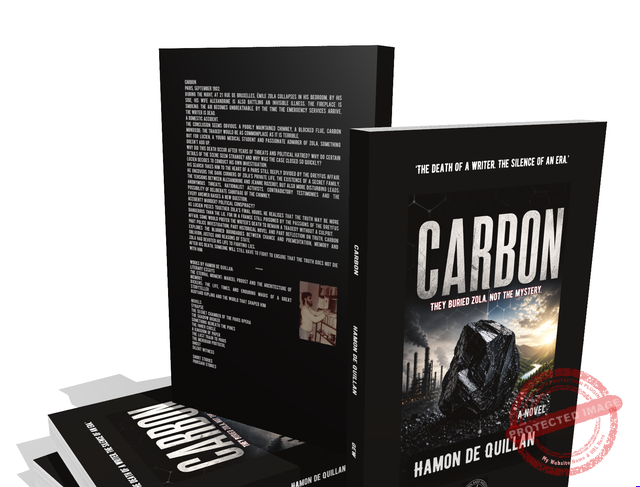

 A Novel by: Hamon de Quillan
- Publisher : Global East-West (GEW)
- Publication date : April 6, 2026
- Language : English
- Print length : 316 pages
It is 2014. Europe is still reeling from the 2008 global financial crisis, its ideals of unity undermined by crippling austerity. Whilst Greek, Spanish and Irish citizens face hospital closures and pension cuts, a silent and legal plundering is draining billions of euros from their countries’ public coffers. Such is the world of Karim Belkacem, a 45-year-old journalist working for The Globe.
In February 2014, Karim receives an encrypted message from a terrified whistleblower working at a ‘Big Four’ audit firm. He is handed a hard drive containing the blueprints of a vast tax evasion network operating out of Luxembourg. The data proves that hundreds of the world’s best-known companies — tech giants, pharmaceutical firms, retail chains — are exploiting complex legal loopholes, sanctioned by governments, to reduce their tax bill to virtually zero.
Karim’s investigation takes him from the gleaming, sterile boardrooms of the Grand Duchy to the public clinics of Athens, which are struggling to survive, highlighting a striking and shocking contrast between the two. The architect of this ‘invisible geography of power’ turns out to be Alexandre de Villiers, a refined and highly intelligent lawyer who presents himself as a mere advocate of market efficiency.
The plot thickens due to a devastating personal conflict: de Villiers is a senior partner at the Parisian law firm where Karim’s ex-wife, Naomi Hayes, works. Her firm is one of the main architects of these financial schemes, and her professional duty—as well as the financial stability of their two children—is directly tied to protecting the very secrets that Karim is determined to expose. Their already strained relationship becomes the battleground for a clash between ideology and family, principles and pragmatism.
As Karim gets closer to the truth, the pressure mounts, ranging from legal threats to covert surveillance and acts of personal intimidation, orchestrated by a network that blurs the line between corporate power and state intelligence services. His investigation culminates in the coordinated global publication of his findings — ‘The Luxembourg Protocol’ — in October 2014, a fictional event intended to precede and trigger the real LuxLeaks scandal, which broke in November 2014.
Available in various formats and editions (Hardcover, paperback, Kindle and Ebook) everywhere in the world
Amazon
Universal Link (Apple, Kobo, Barnes & Noble, FNAC, Waterstone, bookshop.org, etc.)
Chapter One: The Encrypted Message
The rain pounded against the windows of Karim Belkacem’s office with that typically London-like persistence that turned February into a grey, interminable ordeal. It was past eleven o’clock, and the Globe’s newsroom had long since emptied, leaving behind that peculiar silence of abandoned workspaces: the hum of neon lights, the whisper of computer fans, the occasional sigh of the ageing heating system.
Karim stared at his screen, his eyes burning with fatigue, skimming through a draft article on the growing tensions surrounding Brexit for the umpteenth time. Lifeless words lined up before him, clichéd phrases about rising Euroscepticism, the anxiety of the financial markets, the contradictory statements of politicians. It all seemed to him to be revoltingly trite. Forty-five years old, two decades in journalism, and he found himself rehashing the same predictable analyses that any trainee could have produced.
He pushed his chair back, making the castors squeak on the worn linoleum, and unlocked his phone. The screen lit up, revealing the photo he used as his wallpaper: Lili and Sami, taken last summer during their last visit to London. His twelve-year-old daughter was laughing heartily, her brown hair tousled by the Thames breeze. Sami, sixteen, wore that half-smile typical of teenagers who find family photos deeply embarrassing but go along with them anyway, out of affection.
Guilt settled in his chest with the familiarity of an old acquaintance. Three weeks since their last video call. Three weeks in which he’d made excuses, cited deadlines, urgent interviews—a whole arsenal of professional lies to mask a simpler, more painful truth: he no longer knew how to be their father from a distance.
The divorce had been finalised two years earlier, but the emotional landscape of their separation remained hostile territory he had never really learnt to navigate. Naomi lived in Paris with the children, meticulously building the orderly, prosperous life she had always wanted—the one he had never been able to offer her. He remained in London, anchored in this profession that had been both the cause of their break-up and the only thing that still gave meaning to his life.
His computer emitted a quiet beep, bringing him abruptly back to the reality of his cluttered desk. A notification in the bottom right-hand corner of the screen. He frowned. The alert came from his secure email account, the one he reserved for sensitive sources, protected by an encryption system that even The Globe’s IT department considered paranoid.
He clicked on the icon. The message was brief, almost brutal in its brevity:
“I know how they’re doing it. The Grand Duchy. The companies. All of them. Meet me.”
No signature. No details. Just those few words suspended in the digital void, accompanied by an email address that was clearly just a temporary shell, probably created solely for this communication.
Karim sat up slightly. His journalistic instinct, that invisible antenna developed over years of tracking down stories, had just twitched. But almost immediately, scepticism took over. How many times had he received similar messages? Self-proclaimed whistleblowers, conspiracy theorists, professional malcontents who saw conspiracies in every administrative anomaly. Half of them were pathological liars. The other half had something to sell.
His hand moved towards the mouse, ready to drag the message into the ‘Trash’ folder. Then he paused.
The Grand Duchy.
It wasn’t a term just anyone would have used. It was the expression that insiders—people in European financial and legal circles—used when referring to Luxembourg. Not simply ‘Luxembourg’, as an amateur might. The Grand Duchy. That slightly archaic, almost aristocratic phrasing found in internal memos, legal briefs, and corridor conversations among tax lawyers.
His finger tapped the edge of the keyboard. Twenty years in the trade had taught him that genuine whistleblowers never began with grand declarations. They didn’t cite specific documents in their first contact. They tested the waters first, were cautious, sometimes even clumsy in their approach. But they always used the right vocabulary, the insider’s lingo.
He glanced at the wall clock. Almost midnight. Fatigue weighed on his shoulders like a leaden coat. He should go home, take the tube to his flat in Hammersmith, sleep for a few hours before returning tomorrow morning to face the crushing routine of the newsroom.
Karim’s heart beat a little faster. Perhaps.
He opened a new reply window, hesitated for a moment, then typed a single line:
“Prove it.”
Short. Professional. Non-committal. If it was a hoax, his correspondent would vanish. If it was serious, he would have to produce something tangible.
He pressed ‘Send’ and leaned back in his chair, staring at the screen as if it were about to provide him with an instant reply. Naturally, nothing happened. These things took time. Hours, sometimes days.
He shut down the computer, gathered his things, and put on his jacket. The empty Globe newsroom stretched out around him, a familiar landscape of deserted desks and subdued lighting. How many nights had he spent here, chasing stories that led nowhere, verifying facts that turned out to be dead ends? How many times had he sacrificed a dinner with his children, a conversation with Naomi, a moment of normal life, for a story that in the end wasn’t even worth a brief mention on page twelve?
The tube was almost empty at this hour. Karim sat by a window, watching the dark tunnels dotted with yellow lights flash by. His ghostly reflection stared back at him from the glass, and he didn’t like what he saw: a middle-aged man with drawn features, greying hair at the temples, and dark circles under his eyes. A man who had made choices and was now paying the price.
His phone vibrated in his pocket. Probably spam, or perhaps Frank, his editor-in-chief, wanting to know the status of the Brexit article. He ignored it, closing his eyes, letting the rocking of the train lull him into a daze.
But once home, after climbing the four flights of stairs to his flat, after throwing his jacket onto the sofa and pouring himself a whisky he probably wouldn’t drink, he couldn’t help but switch his laptop back on.
The message was there.
A single attached file. PDF format. Twenty-three pages.
Karim opened it, and his world tilted slightly on its axis.
The technical details were complex, involving transfers of intellectual property, intra-group licensing agreements, financial flows circulating between subsidiaries like a continental-scale shell game. But the final result was crystal clear: the company’s effective tax rate in Luxembourg stood at 0.8%.
Less than one per cent.
Karim read the figure three times, certain he had misread it. But no. The calculation was there, scribbled by hand in the margin by someone who had clearly been shocked by what they had discovered. A company generating billions in revenue across Europe was paying proportionally less tax than a supermarket cashier.
He stood up and paced the floor of his cramped studio flat. His mind was already working at full speed, piecing together a jigsaw puzzle of which he currently possessed only a tiny fragment. If one company could do this, how many others had done the same? How long had this been going on? Who, within the Luxembourg government, was signing off on these decisions? And above all, how could this system exist at the very heart of the European Union, an entity that prided itself on transparency and tax fairness?
He returned to his computer and typed a brief reply:
‘Interesting. How many others?’
This time, the reply arrived less than ten minutes later. Just one sentence:
“Hundreds. I can give you everything. But I can’t do it by email. We need to meet.”
Karim felt the adrenaline rush through his veins, that sensation he hadn’t felt for years, since the days when journalism was still a calling and not a routine. He tapped away at the keyboard, thinking about the best approach.
“Where?”
“Eurostar Terminal. Brussels-Midi. Thursday, 3pm. Main hall, near the information desk. I’ll be carrying a black Samsonite laptop bag. Come alone.”
Karim checked his calendar. Thursday. The day after tomorrow. He could take the first Eurostar in the morning, be in Brussels by lunchtime, meet his source, and return that very evening. Frank wouldn’t appreciate him being away without a detailed explanation, but never mind. Some stories couldn’t wait for endless editorial deliberations.
The chat window remained open for a few more seconds, then displayed a message: “User has disconnected.” His contact had vanished as quickly as he’d appeared, leaving behind only a promise and an explosive document.
Karim shut down the computer and slumped onto his sofa, the whisky forgotten within reach. His gaze drifted towards the window, where the rain continued to streak the glass. London slept, indifferent, unaware that hundreds of kilometres away, in the sterile offices of the Grand Duchy, one of the greatest financial scandals of the century might be unfolding.
The next morning, Karim arrived at the office two hours early. The newsroom was still almost empty, with just a few journalists on duty monitoring the international news wires. He settled at his desk and began to dig.
Luxembourg. Two thousand five hundred square kilometres. Six hundred thousand inhabitants. One of the highest per capita GDPs in the world. The headquarters of dozens of European institutions. A haven of political stability and discreet prosperity, nestled between France, Germany and Belgium.
And, if what his informant suggested was true, the epicentre of an industrial-scale tax evasion scheme, operating in plain sight, protected by respectability and impenetrable legal jargon.
He spent the next few hours poring over databases, NGO reports and academic articles. The pieces were beginning to fall into place. Luxembourg wasn’t the only European tax haven – Ireland, the Netherlands and Malta were all playing variations on the same theme – but it seemed to have perfected the art of aggressive tax optimisation disguised as mere administrative efficiency.
“You’ve got a funny look on your face.”
Karim looked up. Frank McAllister was standing by his desk, two steaming coffees in hand. His editor-in-chief was a stocky fifty-eight-year-old Scot, his face weathered by three decades of journalism and a whisky habit he modestly described as “cultural ’. They’d been working together for seven years, and Frank was one of the few people at the Globe who still understood that investigative journalism wasn’t a waste of money but an investment in credibility.
‘I might be onto something,’ said Karim, accepting the coffee. ‘Luxembourg. Large-scale tax evasion. ”
“Exactly. The perfect crime. Everything’s legal, everything’s documented, everything’s approved by the authorities. But the result is the same as if you were robbing a bank: the money disappears.”
“Do you have evidence or just suspicions?”
Karim hesitated. He couldn’t show Frank the document, not yet. Not until he’d met his source and understood the true scale of the case. “I’ve got a contact. Someone on the inside. I’m meeting him on Thursday.”
Frank took a long sip of coffee, his piercing eyes never leaving Karim’s face. “Do you know how many times I’ve heard that line? ‘I’ve got a contact on the inside.’ Half the time, it’s a pathological liar. The other half, it’s someone selling you a story that’s already been published elsewhere.”
“I know.”
“Travel expenses are tight, Karim. The board’s asking us to account for every penny. I can’t send you to Brussels on the basis of a hunch.”
“I’ll pay for it myself.”
Frank raised an eyebrow. “Is it really that promising?”
“Maybe. Or maybe I’m chasing ghosts. But if it’s real… Frank, this could be huge.”
The editor-in-chief stood up, deep in thought. “All right. Go on then. “But Karim, listen to me carefully: make sure it’s solid before you invest any more time in it. We all want to land the big scoop, but we can’t afford to waste three weeks on a lead that goes nowhere. Understood?”
“Understood.”
Frank patted him on the shoulder and walked away towards his glass-walled office. Karim watched him go, then returned to his screen. His phone vibrated. A message from Naomi.
“Don’t forget the bank transfer for Lili’s school fees. Deadline’s tomorrow.”
No “hello”, no pleasantries. Just the pragmatic reminder of a financial obligation. Their communication had been reduced to this: a series of logistical instructions concerning the children, stripped of all warmth, of any trace of affection.
He typed a brief reply: “Done.” Then, after a moment’s hesitation, added: “How are the children?”
The three dots indicating that Naomi was typing appeared, then disappeared. Then reappeared. Finally, the message arrived: “Fine. Sami has an important exam next week. Lili wants to know when you’re coming.”
When you’re coming. Not “if”. The children, in their stubborn optimism, persisted in believing that their father could still be part of their daily lives, that a visit was merely a matter of scheduling and not of emotional geography.
“Soon,” he replied, hating that comfortable lie. “Tell them I love them.”
No reply. He pictured Naomi in her immaculate office in La Défense, surrounded by legal files, corporate contracts, that whole world of figures and clauses she mastered with an ease that had always impressed him. She was in her element there, a rising partner at one of Paris’s most prestigious corporate law firms, meticulously building the career she’d planned since the days they’d met at the Sorbonne, two idealistic students who believed they could change the world.
They had changed, at any rate. Or rather, they had discovered that they wanted to change the world in ways that were fundamentally incompatible.
Karim shook his head, banishing those thoughts. He had a train to catch on Thursday morning, a source to meet, a story to piece together. The past could wait.
On Wednesday evening, he went home early, packed a small travel bag, and tried to sleep. Without success. His mind was going round in circles, working out scenarios, anticipating questions. Who was his informant? A junior auditor who’d uncovered irregularities? A civil servant from the Treasury gripped by remorse? A tax lawyer whose conscience had finally awakened?
Around three in the morning, he gave up and began reading everything he could find on advance tax rulings. The system itself was not illegal, in theory. Companies submitted a detailed description of a proposed structure to the Luxembourg tax authorities, and the authorities issued a ruling indicating how that structure would be taxed. In principle, this provided clarity and predictability. In practice, it allowed large multinationals to secretly negotiate tailor-made tax arrangements, beyond the reach of public debate.
He bought a coffee from the vending machine, passed through security, and boarded the 7.30 am train to Brussels. The Eurostar set off with that silent glide characteristic of modern trains, and London began to roll by outside the window: first the industrial suburbs, then the residential areas, and finally the green countryside of Kent beneath a stubbornly grey sky.
Karim took out his laptop and pretended to work on the Brexit article he was supposed to be finalising. But his thoughts were elsewhere, already in Brussels, at that station where, in a few hours’ time, he might meet the person who would give him access to one of the biggest stories of his career.
Or perhaps he would return empty-handed, having wasted two hundred pounds and a day’s work to meet a paranoid or a fabulist.
The train plunged into the Channel Tunnel, and for twenty minutes there was nothing to see but darkness. Karim closed his eyes, listening to the steady hum of the train hurtling beneath the sea.
When he opened them again, they were emerging into France. The landscape had changed, flatter, more orderly, the fields stretching as far as the eye could see beneath the same leaden sky. The train picked up speed, devouring the miles, and Karim felt that familiar mixture of apprehension and excitement rising within him that always preceded decisive moments.
He sent a quick message to Lili and Sami, just a few words to let them know he was thinking of them. Then he put his phone away and focused on what lay ahead.
At 2.45 pm, the train pulled into Brussels-Midi station. Karim stepped onto the platform, his bag slung over his shoulder, and let himself be carried along by the flow of passengers towards the main hall. The station was organised chaos, a noisy mix of languages and accents, of trains arriving and departing, of incomprehensible announcements blaring from metallic loudspeakers.
He spotted the information desk and settled down nearby, pretending to check his phone whilst scanning the crowd. It was nearly three o’clock. His heart was beating a little faster than he would have liked.
And then he saw him.
Karim approached slowly, cautiously. “Coffee?” he suggested simply.
The young man startled slightly, then nodded. “Not here. There’s a place a bit further on. ”
They walked in silence to a shabby café two streets away from the station, the sort of nondescript place where nobody pays any attention to anyone else. Once seated in a booth at the back of the room, the young man finally set down his bag and held out a trembling hand.
“Julien Fournier.”
“Karim Belkacem.”
They shook hands, and Karim could feel the cold sweat in his companion’s palm.
“Thank you for coming,” said Julien, his voice barely above a whisper. “I… I was afraid you’d think I was mad.”
“The document you sent me seemed quite serious.”
Julien laughed bitterly. “It was nothing. Just a sample. I’ve…” He paused, looked around, then leaned forward. “I’ve got it all. Years of tax rulings. Hundreds of companies. The biggest names you can imagine. Tech, pharmaceuticals, retail, motoring. All of them.”
Karim’s heart skipped a beat. “How did you get access to all that?”
“I work… I worked as a junior auditor at a Big Four firm. Luxembourg office.” He didn’t name the firm, but it didn’t matter. The four major audit and consultancy firms dominated the global market. “We were supposed to check clients’ tax compliance. But what I saw… wasn’t compliance. It was systematic plundering. Legal, perhaps, but it was theft all the same.”
“Tell me.”
“It’s legal,” Julien repeated with painful insistence, as if he were still trying to convince himself. “ It’s all legal. That’s what’s sickening. They’re not criminals, Mr Belkacem. They’re lawyers, accountants, respectable people who go to church on Sundays and sleep soundly at night. They’re not breaking any laws. They’re exploiting the loopholes in the system exactly as it was designed to be exploited.”
“So why are you contacting me?”
Julien stared at him, and for the first time, Karim saw something other than fear in his eyes. Rage, perhaps. Or simply an insurmountable moral despair.
“Because whilst I was building these structures, whilst I was billing hours to help companies reduce their tax bill by a few million more, my sister, who’s a nurse in Liège, told me they had to close hospital wards due to a lack of funding. Do you understand? The two things are linked. Every euro these companies don’t pay is one euro less for hospitals, schools, pensions. And there I was, sitting in my air-conditioned office, optimising it all as if it were just an intellectual game of chess.”
He opened his bag and took out a small external hard drive, which he slid across the coffee-stained table.
“It’s all in there. Years of data. Terabytes. Tax decisions, internal emails, strategic memos, client lists. If you publish this, it’ll send shockwaves through the system.”
Karim didn’t immediately reach for the drive. “Do you understand the risks? For you, I mean?”
“They’ll track me down. Sooner or later. They’re already conducting an internal audit. But they’re not gangsters, Mr Belkacem. They’re pillars of the establishment. They won’t shoot me in an alleyway. They’ll crush me with the law. Prosecution for breach of professional confidentiality, for theft of confidential data, for whatever else they can come up with. They’ll destroy my career, my reputation, maybe put me in prison. But at least the information will be out there. At least people will know.”
Karim took the hard drive, weighed it in his hand. So small, so light, and yet so heavy with potential consequences.
“I need time,” he said at last. “To check all this out, to understand the implications, to build a solid case. Do you have a way to go into hiding?”
“We’ll see later. If everything is confirmed, we’ll publish it, and you’ll be able to testify publicly. You’ll be protected as a whistleblower.”
“Do you really believe that? ” asked Julien with a sad smile. “In legal protections? In the system that protects whistleblowers?”
Karim didn’t reply, because he had no honest answer to offer. He had seen too many sources crushed by the judicial machinery, too many whistleblowers reduced to financial and social ruin, to believe in fairy tales.
They parted ways ten minutes later, having established a secure communication protocol. Julien disappeared into the grey streets of Brussels, and Karim made his way back to the station, the hard drive burning in his inside pocket like a piece of glowing coal.
On the train back to London, he didn’t take out his laptop. He sat by the window, watching the landscape roll by, aware that something irreversible had just happened. He had crossed an invisible line, accepted a responsibility whose full extent he did not yet grasp.
His phone vibrated. A message from Naomi; this time, not a logistical instruction but a direct question:
“Why did you withdraw money in Brussels? It’s from the joint account. What are you doing there?”
Karim closed his eyes. Of course. They’d kept a joint account for the children’s expenses, and she received notifications for every transaction. He typed a vague reply:
“Reporting. Nothing important.”
The reply came almost instantly:
“Don’t be an idiot, Karim. If you’re dealing with anything to do with Luxembourg, you need to be careful. It’s my territory, you understand? Don’t come and mess up my work.”
He reread the message three times, feeling a knot form in his stomach. Her territory. Naomi’s firm, the one where she was on the verge of becoming a partner, had clients in Luxembourg. Of course. All the major Parisian corporate law firms had them. It was a lucrative part of their practice.
He didn’t reply. What could he say? The train sped through the darkness of the Channel Tunnel, and Karim Belkacem sat motionless, the hard drive in his pocket, the phone in his hand, suspended between two worlds that were soon to collide.